How the Internet Works: A Simple Guide for Everyone
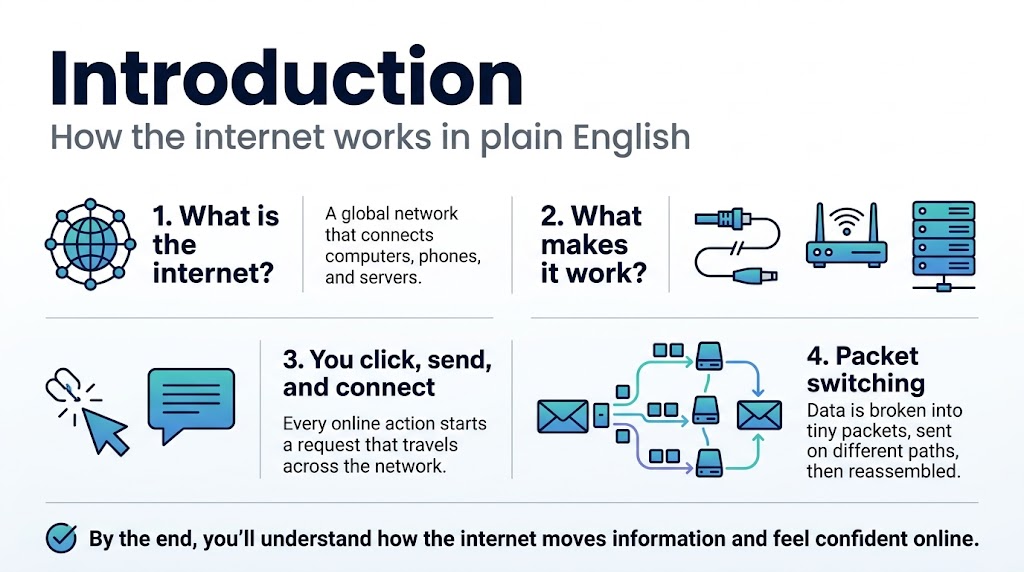
Ever wondered what happens when you click a link or send a message online? You’re about to discover how the internet works in plain English.
This guide is perfect for anyone curious about the technology that connects our world—from complete beginners to tech-savvy folks who want to fill in the gaps. You don’t need any technical background to follow along.
We’ll walk you through understanding what the internet really is and explore the essential components that make the internet work, including the hidden network of cables, routers, and servers that power your daily online activities. You’ll also learn about how your data travels across the internet through a fascinating process called packet switching that breaks your information into tiny pieces and sends them on different routes before reassembling them at their destination.
By the end, you’ll have a clear picture of the internet’s inner workings and feel more confident navigating our connected world.
Understanding What the Internet Really Is
The Internet vs. The World Wide Web
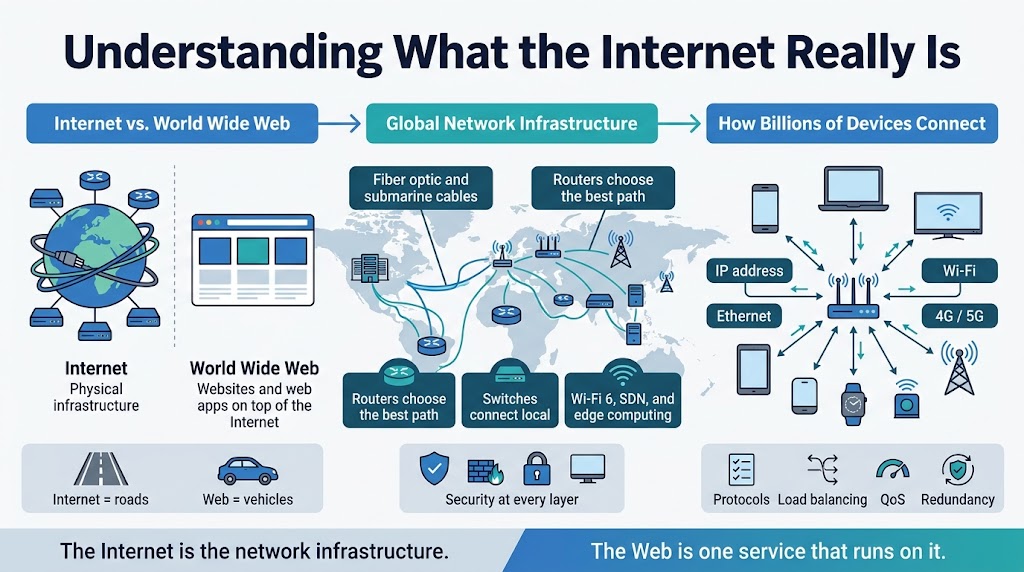
When you first begin exploring how the internet works, it’s crucial to understand that the internet and the World Wide Web are not the same thing, though you might use these terms interchangeably in everyday conversation. This distinction forms the foundation of understanding what you’re actually accessing when you go online.
The internet is the physical infrastructure—the underlying network of networks that connects billions of devices worldwide. Think of it as the highway system that allows data to travel from one location to another. When you use your smartphone, laptop, or any connected device, you’re tapping into this vast network infrastructure that spans the entire globe. The internet consists of the physical cables, wireless signals, routers, switches, and all the hardware components that make connectivity possible.
The World Wide Web, on the other hand, is one of many services that runs on top of the internet infrastructure. It’s the collection of websites, web pages, and web applications that you access through your browser. When you visit a website, you’re using the Web, which is just one application layer that utilizes the internet’s underlying network infrastructure to deliver content to your device.
This relationship is similar to how you might think about roads versus the vehicles that travel on them. The internet is like the road system itself—the physical infrastructure that enables transportation. The Web is like one type of vehicle that uses those roads to get from point A to point B. Other “vehicles” that use the internet infrastructure include email services, file transfer protocols, video streaming platforms, and voice communication applications.
Understanding this distinction helps you grasp that when your data travels across networks, it’s not just moving through “the Web”—it’s utilizing the complex network infrastructure that makes up the internet. The protocols and systems that govern how your data moves are part of the internet’s fundamental architecture, while the websites and web services you interact with represent the Web layer built on top of that infrastructure.
Your access to information, whether you’re checking social media, streaming videos, or sending emails, depends on this robust network infrastructure that operates independently of any single web service or application. This understanding becomes particularly important when you consider how different types of data and applications utilize the same underlying network infrastructure in different ways.
Global Network Infrastructure and Connections
The global network infrastructure that enables your internet access represents one of humanity’s most complex engineering achievements. When you connect to the internet from anywhere in the world, you’re accessing a sophisticated system of interconnected networks that spans continents, oceans, and every corner of the globe.
At its core, this global infrastructure consists of both wired and wireless network components working together seamlessly. Wired networks form the backbone of internet connectivity, with data flowing over various types of cables including fiber optic lines, copper cables, and underwater submarine cables that connect continents. These wired connections provide the high-speed, high-capacity links that carry the majority of global internet traffic.
The physical infrastructure includes massive data centers, internet exchange points, and network operation centers strategically located around the world. These facilities house the servers, routers, and switching equipment that process and route your data as it travels from your device to its destination. When you send an email from New York to London, your data might travel through multiple countries and across ocean floors via submarine cables before reaching its destination.
Wireless networks complement this wired infrastructure by providing you with mobility and flexibility in how you access the internet. Your wireless devices connect to access points, which then link to the wired network backbone. This hybrid approach allows you to maintain connectivity whether you’re sitting at a desk connected via Ethernet or walking around with your smartphone connected to Wi-Fi or cellular networks.
The infrastructure includes several key components that work together to ensure your connectivity. Routers serve as the traffic directors of the internet, making decisions about the most optimal path for your data to travel from source to destination. These devices analyze network conditions in real-time and route your data packets through the most efficient available paths.
Switches play a complementary role by connecting multiple devices within local network segments and managing communication between them. When too many devices connect to the same network segment, switches help prevent congestion by breaking the overall network into smaller groups, ensuring that local traffic in one area doesn’t interfere with traffic in another area.
The global nature of this infrastructure means that your internet experience depends on the coordinated operation of networks owned and operated by thousands of different organizations worldwide. Internet Service Providers (ISPs), telecommunications companies, and network operators all contribute pieces of the global puzzle that enables your connectivity.
Network infrastructure continues evolving to meet growing demands. Organizations worldwide are transitioning to primarily wireless network infrastructures, a trend that accelerated significantly during recent global changes in work patterns. The rise of hybrid workplaces, where you might work from various locations, requires network infrastructure that can reliably and securely support connectivity from anywhere.
This evolution includes the deployment of advanced technologies like Wi-Fi 6, which provides significantly increased bandwidth and improved performance for wireless devices. Wi-Fi 6 access points can handle much higher data volumes and support more simultaneous device connections than previous wireless standards, making them essential for modern network infrastructure.
The infrastructure also incorporates sophisticated management and control systems. Software-defined networking (SDN) approaches allow network administrators to manage and optimize network resources centrally, providing better performance and security for your connections. These systems can automatically adjust network paths, balance traffic loads, and implement security policies in real-time.
Edge computing represents another significant development in global network infrastructure. By placing computing resources closer to where you access services, edge platforms reduce the distance your data needs to travel, improving response times and overall performance. This distributed approach to network infrastructure ensures that popular content and services can be delivered to you more efficiently.
Security measures are built into every layer of this global infrastructure. From encrypted communication protocols to intrusion detection systems, the network infrastructure includes multiple layers of protection to safeguard your data as it travels across networks. Firewalls, access controls, and monitoring systems work continuously to identify and prevent potential threats.
The scalability of modern network infrastructure allows it to grow and adapt to changing demands. As more devices connect to the internet and data usage continues increasing, the infrastructure can expand to accommodate these needs. This scalability ensures that you can continue accessing internet services reliably even as global internet usage continues its dramatic growth.
How Billions of Devices Connect Worldwide
The ability for billions of devices to connect simultaneously across the globe represents a remarkable achievement in network engineering and protocol design. When you connect your smartphone, laptop, smart TV, or any internet-enabled device, you’re joining a vast network that accommodates countless other devices doing the same thing at the exact same moment.
Each device that connects to the internet requires a unique identifier called an IP address. Think of an IP address as a postal address for your device—it tells the network exactly where to send data intended for your specific device. Every time your device connects to the internet, it receives an IP address that identifies both the device itself and its specific location within the network structure.
IP addresses serve as the fundamental addressing system that makes global connectivity possible. When you send data to another device anywhere in the world, that data includes both your device’s IP address and the destination device’s IP address. This addressing system allows routers throughout the global network to make intelligent decisions about where to forward your data packets as they travel toward their intended destination.
The process of assigning and managing billions of IP addresses requires sophisticated coordination. Internet Service Providers and network administrators use dynamic addressing systems that automatically assign IP addresses to your devices when they connect to networks. This dynamic allocation ensures that the available address space can be used efficiently, allowing the same IP addresses to be reused as devices connect and disconnect from networks.
Your devices use various connection methods to access the global network infrastructure. Wired connections typically involve Ethernet cables that connect your device directly to network switches or routers. These wired connections provide stable, high-speed access to the network, making them ideal for devices that require consistent, high-bandwidth connectivity.
Wireless connections offer you greater flexibility and mobility. Your Wi-Fi enabled devices connect to wireless access points, which act as bridges between wireless devices and the wired network infrastructure. These access points receive radio wave signals from your devices and translate them into data that can travel over the wired network backbone.
Cellular connections represent another crucial method for connecting devices to the global network. Your smartphone and other cellular-enabled devices communicate with cell towers, which then connect to the broader internet infrastructure. Advanced cellular technologies like 4G and 5G provide increasingly fast and reliable connections, enabling you to access internet services from virtually anywhere with cellular coverage.
The coordination required to manage billions of simultaneous connections involves multiple layers of network protocols and standards. These protocols define exactly how your devices should format, send, and receive data over the network. When your device wants to communicate with another device, both devices must follow the same protocols to ensure that data can be exchanged successfully.
Network switches play a critical role in managing device connections within local network segments. When multiple devices connect to the same network area, switches intelligently manage communication between them, ensuring that data intended for specific devices reaches the correct destination. Switches also help prevent network congestion by creating separate collision domains for different groups of connected devices.
Routers extend this connectivity beyond local networks by providing connections between different network segments. When your device needs to communicate with a device on a different network, routers analyze the destination address and determine the best path for your data to travel. This routing process happens automatically and continuously as billions of devices send data across the global network.
The scalability of modern network infrastructure ensures that adding new devices to the network doesn’t significantly impact the performance experienced by existing connected devices. Network designers build redundancy and capacity planning into the infrastructure to accommodate growth in the number of connected devices and the amount of data they generate.
Quality of Service (QoS) mechanisms help ensure that your critical applications receive the network resources they need, even when many other devices are competing for the same network capacity. These systems can prioritize certain types of traffic, ensuring that time-sensitive applications like video calls or real-time communications maintain good performance even during periods of high network utilization.
Load balancing systems distribute network traffic across multiple paths and resources to prevent any single network component from becoming overwhelmed. When you access popular online services, load balancing ensures that your connection is routed to available servers and network paths that can provide optimal performance.
The resilience of the global network infrastructure means that if certain network paths become unavailable, alternative routes can be used to maintain connectivity for your devices. This redundancy is built into the network at multiple levels, from individual network links to entire regional network segments.
Modern network infrastructure also incorporates advanced management capabilities that allow network operators to monitor and optimize performance in real-time. These systems can detect potential issues before they impact your connectivity and automatically implement corrective measures to maintain service quality.
The Internet of Things (IoT) represents a significant factor in the growing number of connected devices. Your smart home devices, wearable technology, and connected appliances all require network connectivity, adding to the billions of devices that must be accommodated by the global network infrastructure. These devices often have different connectivity requirements than traditional computers and smartphones, requiring the network infrastructure to support a diverse range of connection types and communication patterns.
Security considerations become increasingly complex as more devices connect to the global network. Each connected device represents a potential entry point for security threats, requiring comprehensive security measures throughout the network infrastructure. Access controls, encryption, and monitoring systems work together to protect not just individual devices but the entire network ecosystem that supports global connectivity.
The continuous evolution of network technologies ensures that the infrastructure can continue supporting ever-growing numbers of connected devices. Advances in wireless technologies, fiber optic communications, and network management systems provide the foundation for accommodating future growth in global device connectivity while maintaining the performance and reliability you expect from your internet connections.
Essential Components That Make the Internet Work
Routers: Traffic Directors of the Digital World
When you think about how the internet works, you need to understand that your data doesn’t magically jump from your device straight to its destination. Instead, it travels through a complex network of interconnected pathways, much like how traffic moves through city streets. At the heart of this digital infrastructure are routers, which serve as the traffic directors of the internet world.
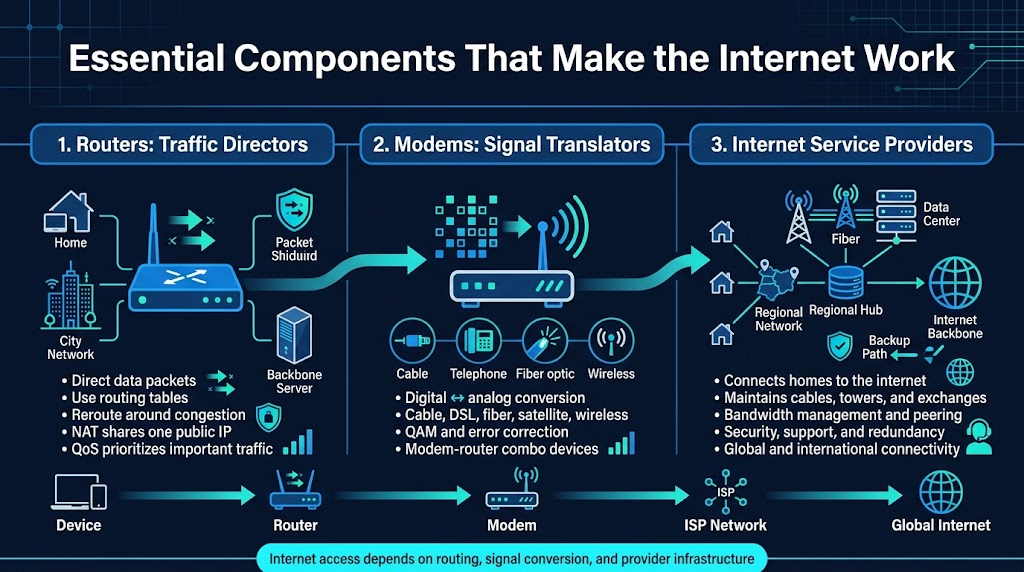
Your router is essentially a specialized computer that makes intelligent decisions about where to send your data packets. Every time you click on a link, send an email, or stream a video, your router determines the best path for that information to travel across the vast network of networks we call the internet. Think of your router as a sophisticated postal worker who not only knows all the addresses in the digital world but also understands the current traffic conditions on every route.
The primary function of your router is to examine each data packet that passes through it and make split-second decisions about where to forward it next. This process happens millions of times per second across the global internet infrastructure. Your home router connects to your Internet Service Provider’s router, which connects to larger regional routers, which then connect to even larger backbone routers that form the core of the internet.
What makes routers particularly intelligent is their ability to maintain routing tables – dynamic databases that contain information about network paths and their current status. These tables are constantly updated through communication with other routers, ensuring that your data always takes the most efficient path available. When you send a request to visit a website, your router consults its routing table to determine which neighboring router should receive your data packet next.
The decision-making process your router uses involves several factors. It considers the destination address of your data packet, the current network congestion levels, the reliability of different paths, and the speed of various routes. If one path becomes congested or fails entirely, your router can automatically reroute your traffic through alternative pathways, ensuring that your internet connection remains stable and efficient.
Your home router also performs a crucial security function through Network Address Translation (NAT). This process allows multiple devices in your home to share a single public IP address while maintaining separate private IP addresses internally. When data returns from the internet, your router knows exactly which device requested that information and forwards it accordingly.
Modern routers incorporate advanced features that enhance your internet experience. Quality of Service (QoS) capabilities allow your router to prioritize certain types of traffic, ensuring that your video calls remain clear even when other devices are downloading large files. Dual-band and tri-band routers can separate different types of traffic across multiple frequency bands, reducing congestion and improving overall performance.
The physical design of routers varies significantly depending on their intended use. Your home router might be a small box with several antenna ports, while enterprise routers used by businesses can be massive rack-mounted units with dozens of ports and redundant power supplies. Backbone routers that form the core of the internet are even larger and more sophisticated, capable of handling millions of packets per second.
Router configuration plays a vital role in optimizing your internet experience. Through your router’s administrative interface, you can adjust settings that control how your network operates. You can set up port forwarding for specific applications, configure wireless security settings, establish guest networks, and monitor bandwidth usage across different devices.
The evolution of router technology continues to advance rapidly. Software-defined networking (SDN) allows for more flexible and programmable router behavior, while artificial intelligence integration enables routers to learn from traffic patterns and optimize performance automatically. These advancements ensure that routers can handle the ever-increasing demands of modern internet usage.
Understanding how your router manages traffic helps you appreciate the complexity of internet communications. Every time you load a webpage, your router must coordinate with potentially dozens of other routers to establish the most efficient path for your data. This coordination happens so quickly and seamlessly that you rarely notice the sophisticated decision-making process occurring behind the scenes.
The reliability of routers is crucial for maintaining internet connectivity. Redundant routing protocols ensure that if one router fails, traffic can automatically reroute through alternative paths. This redundancy is built into the fundamental design of the internet, making it remarkably resilient to individual component failures.
Modems: Converting Digital to Analog Signals
Now that we’ve explored how routers direct traffic within digital networks, let’s examine the crucial role that modems play in bridging the gap between your digital devices and the physical infrastructure that carries internet signals. Your modem serves as the essential translator between the digital language your devices speak and the analog signals that travel through various transmission media.
The term “modem” comes from “modulator-demodulator,” which perfectly describes its primary function. When you send data from your computer, that information exists as digital signals – sequences of ones and zeros that represent your emails, web requests, and file downloads. However, the physical infrastructure that carries this data over long distances often requires analog signals, which are continuous waves that can travel more effectively through cables, fiber optic lines, and wireless transmissions.
Your modem performs this critical conversion process in both directions. When you upload data, your modem modulates the digital signals from your devices into analog signals suitable for transmission across your ISP’s network. When data arrives from the internet, your modem demodulates those analog signals back into digital format that your devices can understand and process.
Different types of modems work with various transmission technologies, each designed to handle specific types of physical connections. Cable modems work with the coaxial cables originally installed for cable television, using available frequency bands to transmit internet data alongside TV signals. These modems can achieve impressive speeds by utilizing multiple channels simultaneously, a technique called channel bonding.
DSL modems operate over traditional telephone lines, taking advantage of frequency ranges that don’t interfere with voice communications. This allows you to use your phone and internet connection simultaneously over the same physical line. DSL modems use sophisticated signal processing to maximize data transmission rates while maintaining signal quality over potentially long distances from your ISP’s central office.
Fiber optic modems, often called Optical Network Terminals (ONTs), work with fiber optic cables that transmit data as light pulses rather than electrical signals. These modems convert digital data into specific light frequencies for transmission and then convert received light signals back into digital format. Fiber optic connections typically provide the fastest internet speeds available to residential users.
Satellite modems enable internet access in areas where terrestrial infrastructure isn’t available. These specialized modems communicate with satellites positioned in geostationary orbit, handling the significant time delays and signal processing challenges associated with this type of connection. The modulation techniques used by satellite modems must account for atmospheric interference and the vast distances involved in satellite communication.
Wireless modems, including those built into smartphones and mobile hotspot devices, work with cellular networks to provide internet access. These modems handle the complex modulation schemes used in modern cellular technologies like 4G LTE and 5G, adapting to varying signal conditions and automatically adjusting transmission parameters for optimal performance.
The modulation techniques used by modern modems have become increasingly sophisticated. Early modems used simple frequency-shift keying, where different tones represented different data values. Contemporary modems employ advanced techniques like Quadrature Amplitude Modulation (QAM), which can encode multiple bits of data into each transmitted symbol, dramatically increasing data transmission rates.
Your modem’s performance directly impacts your internet experience. Factors like signal-to-noise ratio, line quality, and distance from your ISP’s equipment all influence how effectively your modem can convert between digital and analog signals. Modern modems include adaptive technologies that continuously monitor line conditions and adjust their operation to maintain optimal performance.
Error correction and data compression built into modern modems help ensure reliable data transmission even when line conditions are less than ideal. These technologies can detect and correct transmission errors automatically, while compression algorithms reduce the amount of data that needs to be transmitted, effectively increasing your connection’s throughput.
The integration of modems with routers has become increasingly common, resulting in combination devices that provide both signal conversion and traffic routing functions. These modem-router combinations simplify home networking by reducing the number of separate devices needed while often providing cost savings compared to purchasing separate units.
Configuration options in modern modems allow you to optimize performance for your specific connection and usage patterns. Advanced modems provide detailed diagnostic information about signal quality, error rates, and connection statistics, helping you troubleshoot performance issues and optimize your internet connection.
Understanding your modem’s role in the internet connection process helps you appreciate the complex signal processing that occurs every time you access online content. The seamless conversion between digital and analog signals happens millions of times per second, enabling the high-speed internet access we’ve come to expect in our daily digital activities.
Internet Service Providers and Their Role
With our understanding of how routers direct traffic and modems convert signals, we can now explore the crucial role that Internet Service Providers play in connecting you to the global internet infrastructure. Your ISP serves as your gateway to the internet, providing the essential link between your home network and the vast network of networks that comprise the global internet.
Your relationship with your ISP begins with the physical infrastructure they maintain and operate. This infrastructure includes the cables, fiber optic lines, wireless towers, and switching equipment that carry internet traffic to and from your location. When you sign up for internet service, you’re essentially purchasing access to this infrastructure and the bandwidth capacity it can provide.
The process of connecting your home to the internet involves multiple layers of ISP infrastructure. At the local level, your ISP maintains a network that reaches individual homes and businesses in your area. This local network connects to regional facilities that aggregate traffic from multiple local areas. These regional facilities then connect to major internet exchange points and backbone networks that form the core of the global internet.
Your ISP’s network operations center serves as the command hub for monitoring and managing their entire infrastructure. Skilled technicians work around the clock to ensure network reliability, monitor traffic patterns, and respond quickly to any issues that might affect your internet service. This continuous monitoring is essential because internet traffic patterns change constantly throughout the day, requiring dynamic adjustments to maintain optimal performance.
The peering relationships your ISP maintains with other networks are crucial for your internet access. Peering agreements allow different ISPs and networks to exchange traffic directly, rather than routing it through intermediate networks. Your ISP negotiates these agreements to ensure that your data can reach its destination efficiently, regardless of which network hosts the content you’re trying to access.
Bandwidth management is another critical function your ISP performs. They must carefully balance the available capacity across all their customers to ensure everyone receives the service level they’ve purchased. This involves sophisticated traffic engineering techniques that prioritize different types of data based on their importance and time sensitivity.
Your ISP also plays a vital role in cybersecurity and network protection. They implement various security measures to protect their infrastructure and customers from cyber threats, including distributed denial-of-service attacks, malware distribution, and other malicious activities. Many ISPs offer additional security services to help protect your devices and data from online threats.
The customer service and technical support provided by your ISP are essential for maintaining your internet connection. When you experience connectivity issues, ISP technicians can remotely diagnose problems with your connection, determine whether issues originate from your equipment or their network, and dispatch field technicians when necessary to resolve physical infrastructure problems.
Different types of ISPs serve various market segments and geographic areas. Tier 1 ISPs operate the largest backbone networks and don’t purchase internet transit from other providers. Tier 2 ISPs maintain significant networks but may purchase some connectivity from Tier 1 providers. Tier 3 ISPs typically focus on providing internet access to end users and purchase most of their upstream connectivity from larger providers.
The service level agreements your ISP provides define the terms and expectations for your internet service. These agreements specify factors like expected uptime, bandwidth guarantees, response times for technical support, and compensation for service outages. Understanding these agreements helps you know what to expect from your internet service and what recourse you have if service doesn’t meet specified standards.
Geographic coverage areas significantly influence how ISPs design and operate their networks. Rural ISPs face unique challenges in providing service across large areas with relatively few customers per square mile. Urban ISPs must handle high customer density and significant bandwidth demands in concentrated areas. These different operating environments require distinct approaches to network design and capacity planning.
The competitive landscape among ISPs in your area directly affects the service options and pricing available to you. In areas with multiple competing ISPs, you typically have more choices for internet plans, better customer service, and more competitive pricing. Markets with limited competition may have fewer options and higher prices, though regulatory requirements often ensure basic service availability.
Innovation in ISP services continues to evolve with advancing technology. Many ISPs now offer bundled services that include internet access, television, phone service, and mobile connectivity. They’re also investing in network upgrades to support faster speeds, lower latency, and emerging technologies like Internet of Things devices and virtual reality applications.
The regulatory environment governing ISPs affects how they operate and the services they can offer. Net neutrality regulations, privacy requirements, and service availability mandates all influence ISP operations. Understanding these regulations helps you know your rights as an internet customer and what protections are in place regarding your internet service and data privacy.
Your ISP’s network capacity planning involves predicting future bandwidth demands and upgrading infrastructure accordingly. This planning process must account for changing usage patterns, new technologies, and population growth in their service areas. Effective capacity planning ensures that your internet service remains fast and reliable even as overall internet usage continues to increase.
The pricing models used by ISPs reflect the costs of maintaining and operating their networks. Factors like infrastructure investment, ongoing maintenance, customer support, and competitive pressures all influence the rates you pay for internet service. Understanding these cost factors can help you evaluate the value proposition of different service plans and providers.
International connectivity provided by your ISP enables you to access content and services hosted anywhere in the world. Your ISP maintains connections to international internet exchanges and submarine cables that carry internet traffic between continents. This global connectivity is what makes the internet truly worldwide, allowing you to communicate and access information regardless of geographic boundaries.
The reliability and redundancy built into ISP networks ensure that your internet connection remains available even when individual components fail. Most ISPs design their networks with multiple redundant paths, backup power systems, and failover capabilities that automatically reroute traffic when problems occur. This redundancy is crucial for maintaining the continuous internet access that modern life requires.
At Heyamico, our goal is to explain technology in the simplest way possible so everyone can learn and grow in the digital world.