What Would Happen If Earth Stopped Spinning?
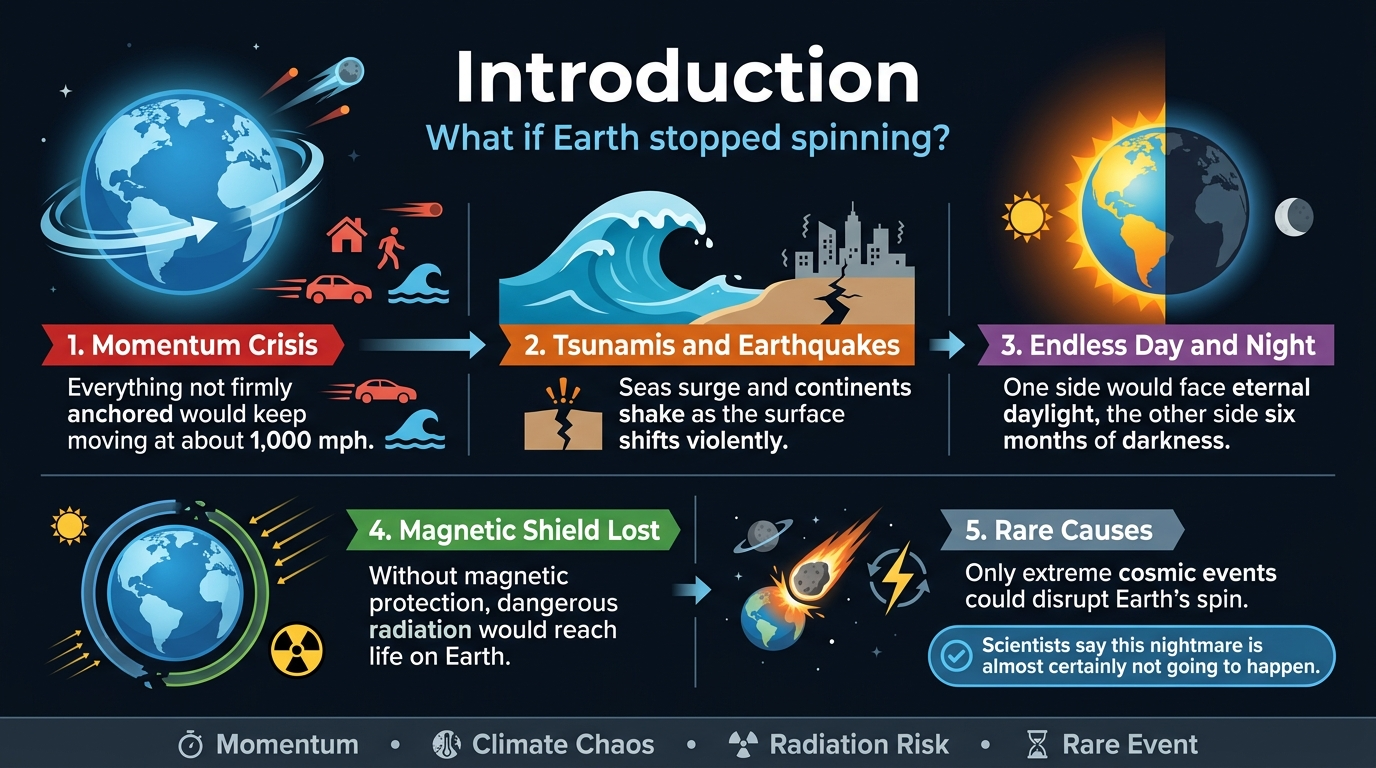
If our planet suddenly stopped rotating, the results would be nothing short of apocalyptic. Everything not firmly anchored to Earth’s surface—including you, your house, and entire oceans—would keep hurtling forward at roughly 1,000 mph due to momentum. But the catastrophic effects wouldn’t end there.
This guide breaks down the terrifying chain of events that would unfold if earth stopped spinning. You’ll discover the immediate disasters that would strike first, from devastating tsunamis to continent-reshaping earthquakes. We’ll explore how day night cycle changes would transform our world into a place of eternal daylight and darkness lasting six months each. You’ll also learn why losing Earth’s magnetic field protection could spell doom for all life, and examine the rare cosmic scenarios that could actually disrupt our planet’s rotation—plus why scientists say you can sleep soundly knowing this nightmare scenario will almost certainly never happen.
Long-Term Changes to Day and Night Cycles
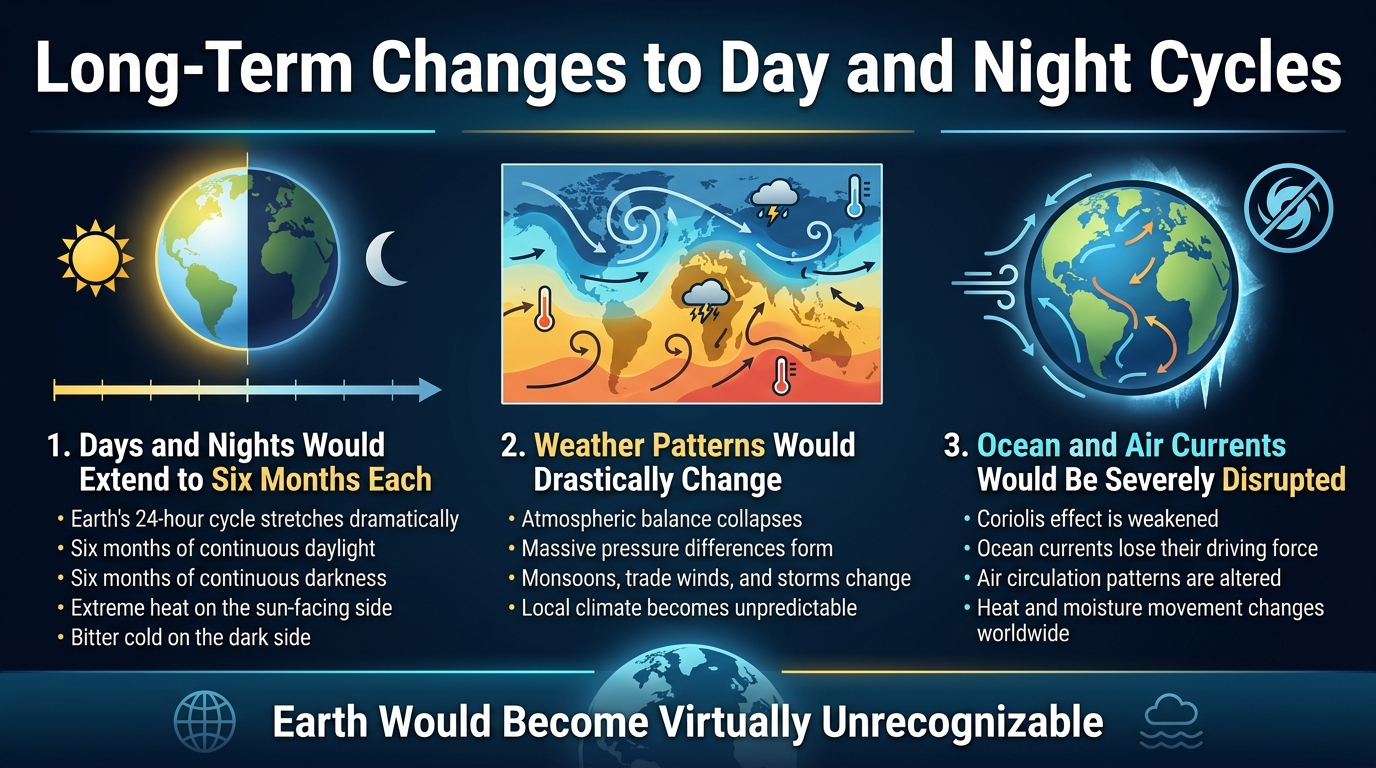
Days and Nights Would Extend to Six Months Each
If you imagine a scenario where earth stopped spinning gradually, you’d witness one of the most dramatic transformations in planetary history. The familiar 24-hour day night cycle that governs your daily life would slowly stretch until each period of daylight and darkness lasted a staggering six months. This earth rotation disruption would fundamentally alter how you experience time itself.
During the six-month daylight period, your hemisphere would face continuous solar radiation, creating extreme temperature conditions that would make current heatwaves seem mild. Conversely, the six-month night period would plunge your region into prolonged darkness and bitter cold, as no solar energy would reach your area for half a year. This catastrophic earth scenario would eliminate the natural rhythm that all life on Earth has evolved to depend upon.
Weather Patterns Would Drastically Change
Your planet’s weather systems would undergo unprecedented transformation if earth stopped rotating. The delicate balance of atmospheric conditions that you rely on for stable weather would collapse entirely. Temperature extremes between the perpetually sun-facing and dark sides of Earth would create massive pressure differentials, generating weather patterns unlike anything you’ve ever experienced.
The gradual transition to these extended day night cycle changes would mean your local climate would become increasingly unpredictable before settling into the new six-month pattern. You’d witness the breakdown of seasonal weather cycles, as the mechanisms that drive familiar patterns like monsoons, trade winds, and storm systems would be fundamentally altered by the earth rotation effects.
Ocean and Air Currents Would Be Severely Disrupted
What would happen if earth stopped rotating extends far beyond just day and night changes – your planet’s entire circulation system would face severe disruption. The ocean and air currents that you depend on for climate regulation are strongly influenced by Earth’s rotation through the Coriolis effect. Without this rotational force, these crucial systems would be severely disrupted.
Your ocean currents, which currently distribute heat around the globe and regulate temperatures, would lose their rotational driving force. This disruption would affect everything from marine ecosystems to coastal climates that you might live near. Similarly, atmospheric circulation patterns that move air masses and moisture around the planet would be severely compromised, fundamentally altering how weather systems develop and move across your region.
The consequences of these earth spinning consequences would ripple through every aspect of your environment, from the water cycle to global temperature distribution, creating a planet that would be virtually unrecognizable from the one you know today.
Critical Threat to Earth’s Magnetic Field Protection
Rotation Loss Could Weaken Earth’s Magnetic Field
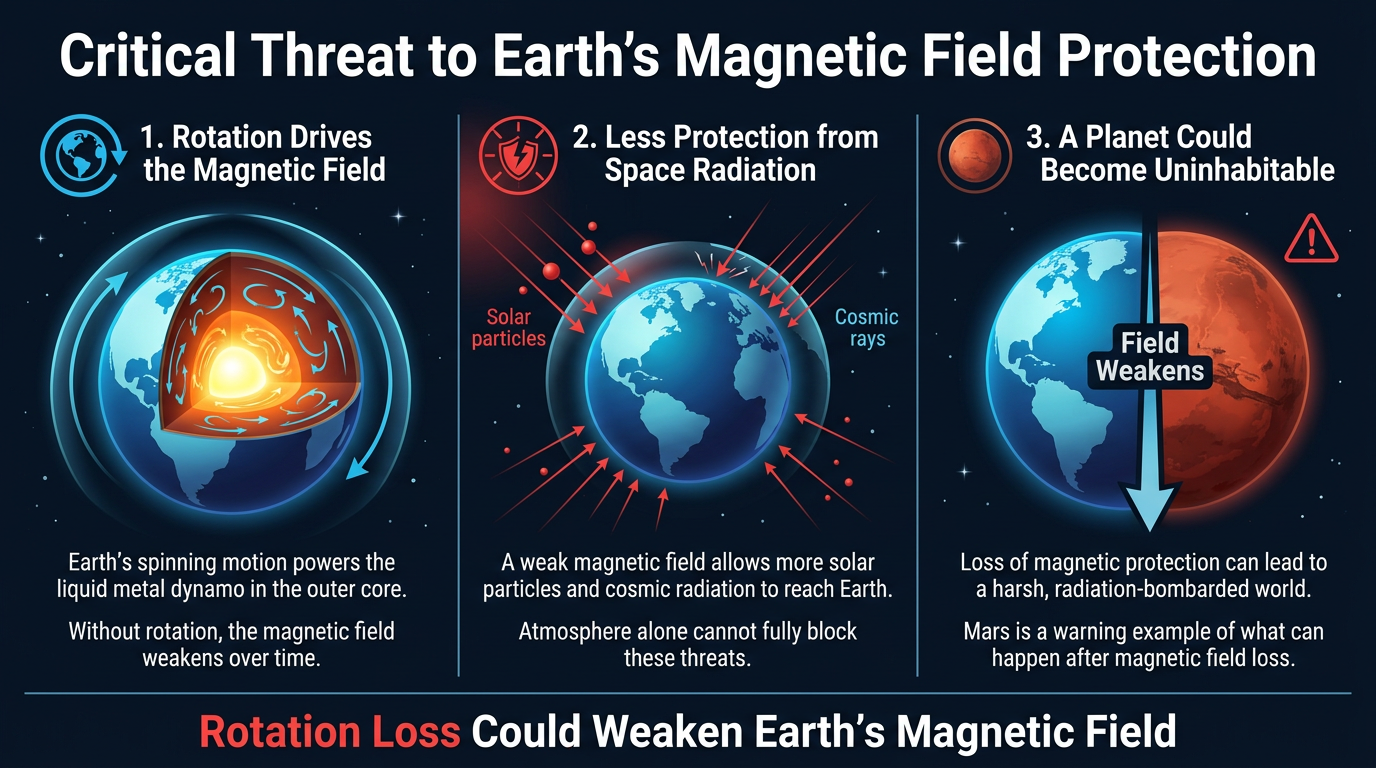
When considering the catastrophic consequences of earth rotation disruption, you must understand that our planet’s magnetic field depends entirely on Earth’s spinning motion. Your planet’s magnetic field originates from the flowing liquid metal in our outer core, a process that requires Earth’s continuous rotation to function properly. Without this rotational movement, the complex dynamo effect that generates your protective magnetic field would begin to weaken dramatically.
As Earth’s rotation slows or stops completely, you would witness a gradual but devastating decline in magnetic field strength. This earth magnetic field deterioration wouldn’t happen overnight, but the long-term implications for life on your planet would be severe. The flowing liquid metal in the outer core relies on rotational forces to maintain the electrical currents that create our magnetic shield, making rotation absolutely essential for your planet’s protective systems.
Reduced Protection from Harmful Space Radiation
Now that we have covered how rotation affects magnetic field generation, you need to understand the direct threat this poses to your survival. Your planet’s magnetic field serves as a crucial barrier protecting you from harmful radiation emanating from space. When earth stopped spinning scenarios occur, this protection would gradually diminish, exposing you and all life on Earth to dangerous cosmic radiation and solar particles.
Without adequate magnetic field protection, you would face increased exposure to radiation levels that could prove lethal to most forms of life. Your atmosphere alone cannot provide sufficient shielding from these space-based threats, making the magnetic field your primary defense system. The weakening of this protective barrier represents one of the most serious earth spinning consequences you could imagine.
Potential for Earth to Become Uninhabitable Like Mars
With this deteriorating protection in mind, you should consider the ultimate fate that could await your planet. The loss of Earth’s magnetic field could potentially contribute to making your world uninhabitable, following a similar path that researchers believe Mars experienced in its distant past. This comparison to Mars provides a sobering example of what happens when a planet loses its magnetic field protection.
You can observe Mars today as a cautionary tale of planetary magnetic field failure. Scientists theorize that Mars once possessed a protective magnetic field similar to Earth’s, but lost this crucial defense system, leading to its current barren and inhospitable conditions. If earth stopped rotating and your magnetic field weakened sufficiently, your planet could follow this same catastrophic trajectory, transforming from the vibrant, life-supporting world you know into a desolate, radiation-bombarded wasteland incapable of sustaining life as you understand it.
Why Earth Won’t Actually Stop Spinning
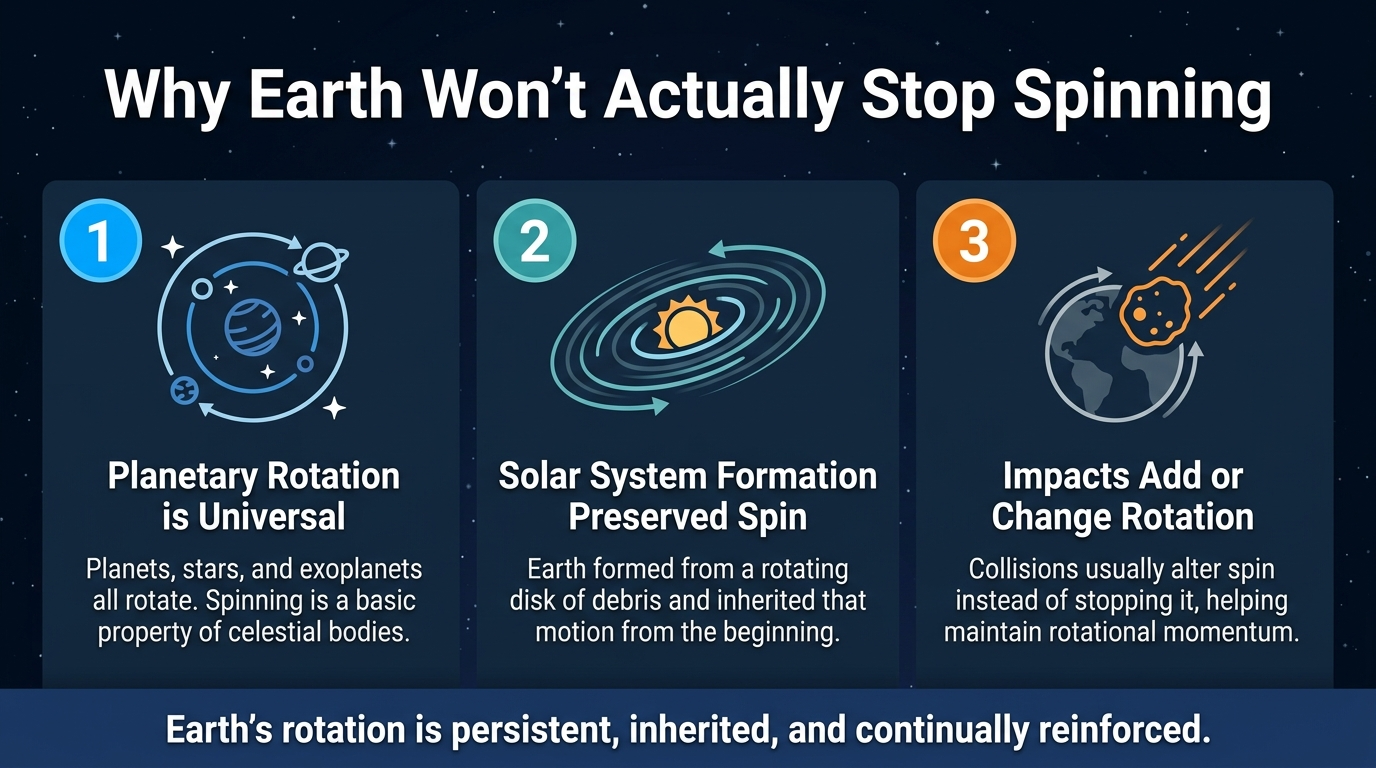
Planetary Rotation is a Universal Phenomenon
When you consider the possibility of earth stopped spinning, you should understand that planetary rotation represents a fundamental characteristic observed throughout the universe. Every known planet in our solar system and beyond demonstrates rotational movement, making it an inherent property of celestial bodies. This universal phenomenon extends beyond just planets—even stars exhibit rotational motion, indicating that spinning is deeply embedded in the nature of cosmic objects.
The consistency of this rotational behavior across all planetary bodies suggests that the forces and mechanisms responsible for rotation are fundamental aspects of how celestial objects form and maintain their existence. You can observe this pattern not only in our solar system but also in the exoplanets discovered orbiting distant stars, reinforcing the idea that rotation is not an exception but rather the rule in planetary physics.
Solar System Formation Ensures Continued Rotation
Your understanding of why earth rotation effects persist requires examining how our solar system originally formed. The entire solar system emerged from a massive disk of debris that surrounded the developing sun during its early formation. This primordial disk contained all the material that would eventually coalesce to form the planets, including Earth.
Since this foundational material was already circling around the sun within this rotating disk, the planets that formed from this debris inherited this rotational momentum. This formation process explains why most planets in our solar system rotate in the same direction—they all originated from the same spinning disk of material. The rotational energy established during this formation phase continues to drive Earth’s spinning motion billions of years later, making any disruption to this rotation extremely unlikely under normal circumstances.
Planetary Impacts Maintain Rotational Movement
You should also recognize that planetary impacts play a crucial role in maintaining and influencing rotational movement. Throughout Earth’s formation and continuing existence, objects have collided with our planet, contributing to its rotational energy. These impacts don’t typically stop rotation—instead, they often enhance or modify it.
The physics of these collisions reveals that unless objects hit each other in a perfectly head-on trajectory, one or both objects involved will begin spinning or have their existing rotation altered. This means that the various asteroids, comets, and other debris that have struck Earth throughout its history have actually contributed to maintaining its rotational momentum rather than stopping it. These ongoing interactions with space objects serve as additional factors that help preserve Earth’s continued spinning motion.
Rare Scenarios That Could Disrupt Earth’s Rotation
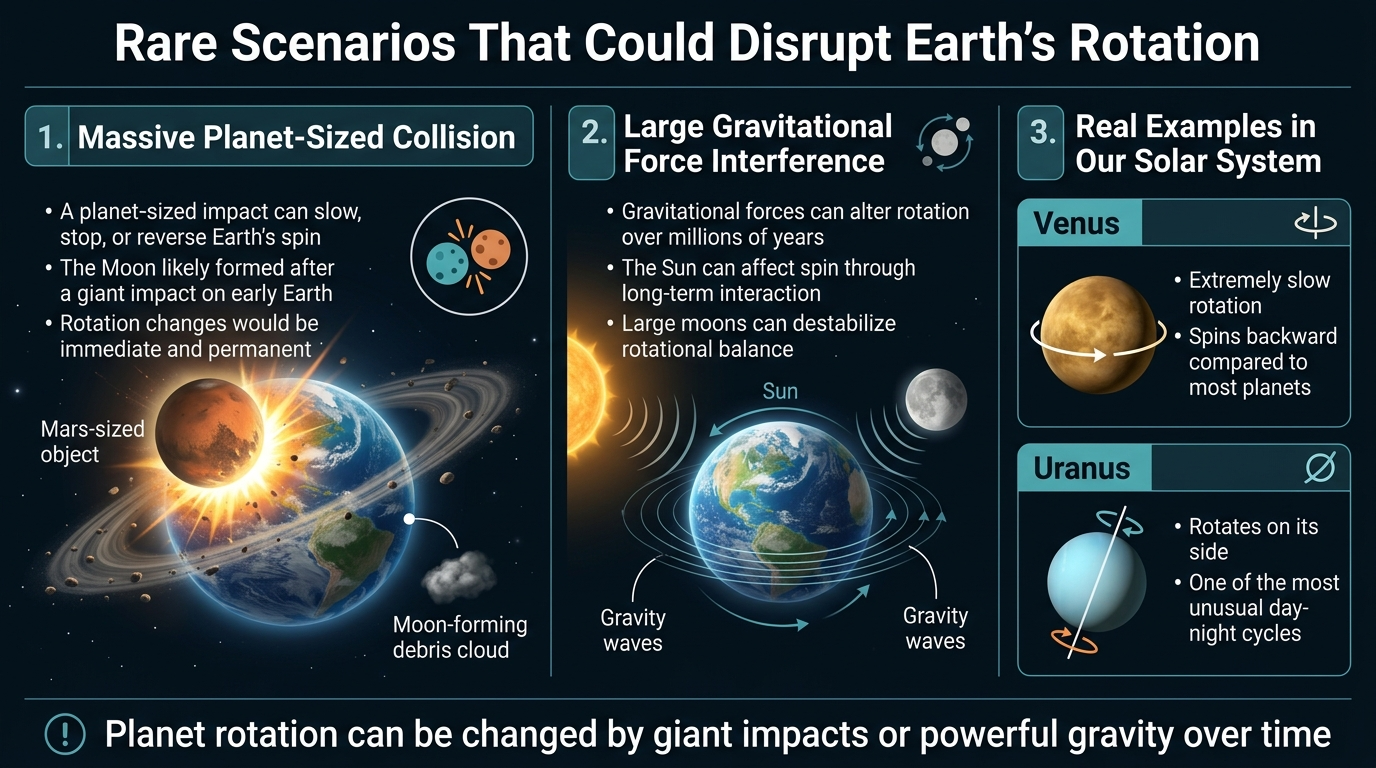
Massive Planet-Sized Object Collision
When you consider what could actually disrupt Earth’s rotation, the most dramatic scenario involves a massive, planet-sized object slamming into our planet. This type of catastrophic collision could fundamentally alter how Earth spins, potentially counteracting Earth’s current spin entirely, dramatically slowing it down, or even causing it to spin in the opposite direction.
You might be surprised to learn that such a collision has actually happened before in Earth’s history. The formation of our Moon is believed to have resulted from exactly this type of massive impact. When a Mars-sized object collided with the early Earth billions of years ago, it not only created the debris that would eventually form the Moon but also significantly affected Earth’s rotational characteristics.
If you witnessed such an event today, the consequences for earth rotation effects would be immediate and permanent. The sheer force of a planet-sized collision would transfer enough energy to completely override Earth’s current rotational momentum, fundamentally changing the day night cycle changes that life on Earth depends upon.
Large Gravitational Force Interference
Beyond direct collisions, you should understand that large gravitational forces can also dramatically disrupt a planet’s rotation over time. These gravitational effects earth rotation experiences can come from various sources, including the sun’s gravitational influence or interference from large moons.
When you examine how gravitational forces affect planetary rotation, you’ll find that the sun’s gravitational force can interact with a planet’s thick atmosphere to gradually alter its spin. This type of gravitational interference doesn’t require a direct collision but instead works through sustained gravitational interaction over millions of years.
You’ll also discover that large moons can create similar disruptions. The gravitational relationship between a planet and its moon system can gradually change rotational characteristics, especially when the gravitational forces become unbalanced or when multiple large bodies interact with a planet simultaneously.
Examples from Venus and Uranus Rotational Changes
Now that we’ve covered the mechanisms behind rotational disruption, you can examine real examples of planets that have experienced these catastrophic earth scenarios. Venus and Uranus serve as perfect case studies for understanding what happens when planetary rotation gets disrupted.
When you look at Venus, you’ll notice it rotates extremely slowly and in the backward direction compared to most other planets. This unusual rotation pattern is thought to result from the types of forces we’ve discussed – either a massive collision or sustained gravitational interference that completely altered its original rotation.
You’ll find Uranus presents an even more extreme example of earth rotation disruption. This planet rotates in the opposite direction and spins on its side, creating the most unusual day-night cycle in our solar system. Like Venus, Uranus is believed to have had its original rotation completely disrupted by catastrophic events in its past.
These examples show you that while earth stopped spinning scenarios are theoretical for our planet today, such dramatic changes to planetary rotation have occurred elsewhere in our solar system, demonstrating that the physics behind these planet rotation physics concepts are not just theoretical but have real-world precedents.
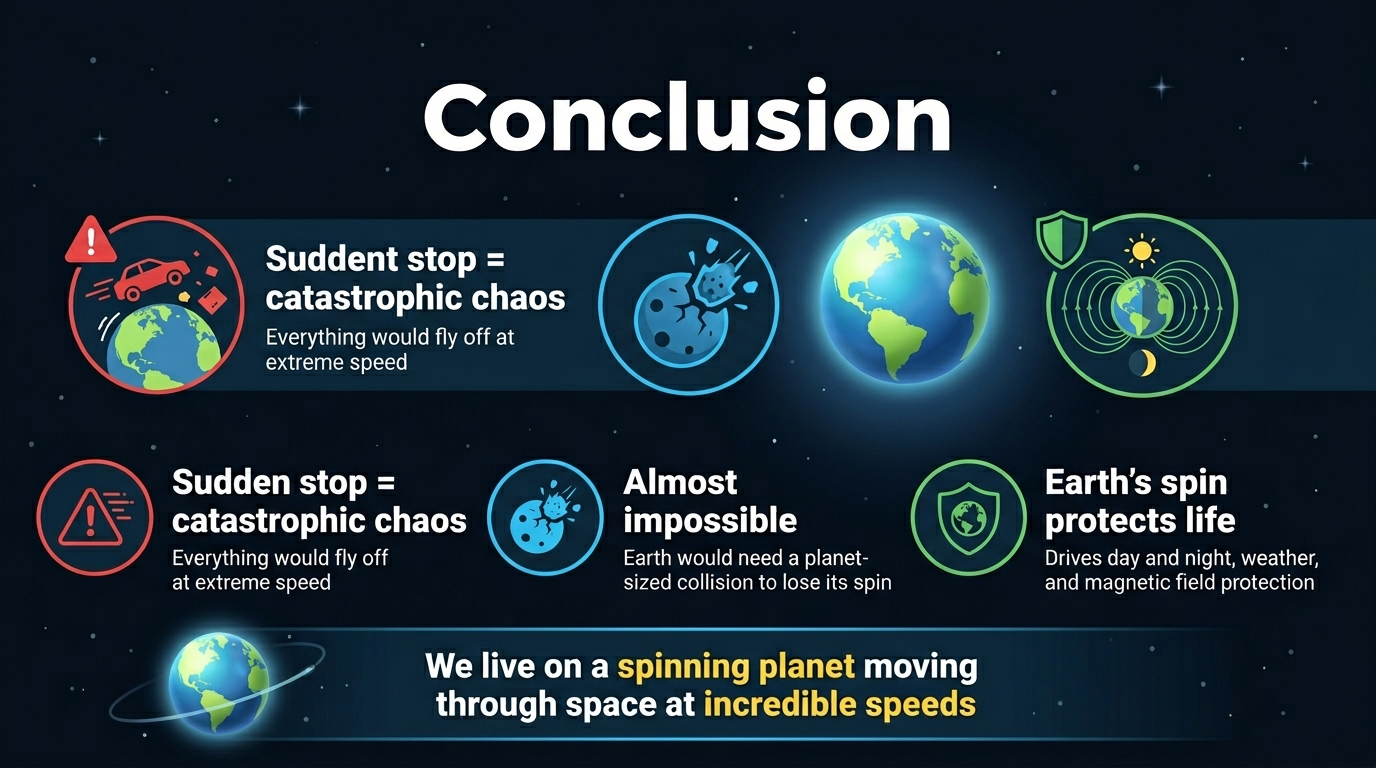
While the catastrophic scenarios of Earth suddenly stopping its rotation paint a terrifying picture—from everything flying off the surface at 1,000 mph to six-month-long days and nights—you can rest assured that such an event is extraordinarily unlikely. The physics of planetary formation and the stable orbits in our modern solar system make it virtually impossible for Earth to lose its spin without a planet-sized collision, which would present far greater concerns than rotation alone.
Understanding these extreme scenarios helps you appreciate the delicate balance that makes life on Earth possible. From the magnetic field protection generated by our planet’s rotation to the weather patterns and day-night cycles we depend on, Earth’s spin is fundamental to our survival. The next time you feel the ground beneath your feet, remember that you’re actually hurtling through space on a spinning planet at incredible speeds—and be grateful that this remarkable dance will continue for billions of years to come.